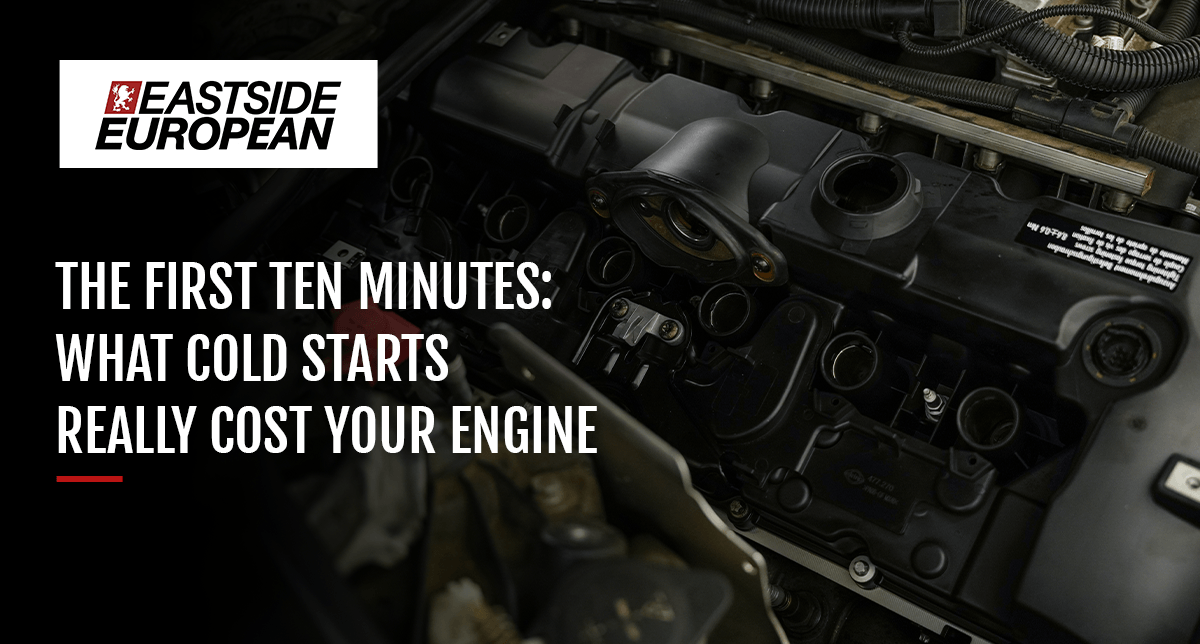
The First Ten Minutes: What Cold Starts Really Cost Your Engine
Here is the single most useful thing in this article, and almost nobody knows it.
Your temperature gauge is measuring the wrong fluid.
That needle reports coolant temperature. Coolant warms quickly — it circulates through the head and block, and the thermostat stays shut during warm-up specifically to trap heat where it is being made. So the gauge reaches the middle and settles, and you reasonably conclude the engine is warm.
But the fluid that actually protects your engine is the oil, and oil sits in a pan underneath the engine, exposed to the air rushing past, a long way from the heat. It warms far more slowly — commonly lagging coolant by ten to fifteen minutes of driving.
Which means the moment most drivers consider their car "warmed up" is roughly the moment the oil is still cold.
First, a myth we are not going to repeat
You will find it everywhere: "75% of engine wear happens at startup." Or 80%. Or 90%, depending on the forum.
We went looking for the primary source and could not find a credible one. It gets repeated endlessly without attribution, and the number shifts depending on who is repeating it — which is usually the signature of folklore rather than research.
So we are not going to use it. The mechanism behind cold-start wear is real, well understood, and does not need an invented statistic propping it up. Here is the mechanism instead.
What is actually happening in those ten minutes
At the moment of starting, the oil is in the wrong place. It has spent the night draining down into the sump. When you turn the key there is a brief period before pressure builds and a full oil film is re-established everywhere it needs to be — the bearings, the chain tensioner, the turbocharger bearings. That window is short, but it is the one moment in the day when moving parts are least protected.
Cold oil is also the wrong viscosity. One source describes it well: honey in a refrigerator. Worth knowing how the grade works — in 5W-30, the "5W" describes cold flow, while the "30" refers to the oil's behaviour at 100°C (212°F). In other words, the viscosity your engine was designed around only exists once the oil is hot. Until then you have sluggish flow, an oil pump working harder, slower delivery to the places that need it, and meaningful internal drag.
The timing chain tensioner is hydraulic. It runs on oil pressure, and it bleeds down while the engine is off. On start-up there is a moment of slack chain before pressure rebuilds and takes it up — which is precisely the brief cold-start rattle we have written about before. Every cold start works that component at its most vulnerable.
The engine deliberately runs rich to light the catalyst. This is the part with proper research behind it. Work at Empa, the Swiss federal materials science and technology laboratory, found that 90% of all pollutants from a modern gasoline engine are produced in the first minute after a cold start — and that the first 500 metres on the road pollute roughly as much as the next 5,000 kilometres of continuous driving. The reason is that the catalytic converter does almost nothing until it reaches around 300°C, so the engine runs rich to heat it as fast as possible.
That richness has a mechanical consequence as well as an environmental one: extra fuel washing down the cylinder walls, which is where fuel dilution of the oil begins.
Most cold-running wear happens at the rings and bores — the place where cold, thick oil meets cylinder pressure and that fuel wash.
And water forms. Combustion produces water vapour, and until the engine and exhaust reach full temperature it condenses rather than leaving. In a cool, damp climate, on short trips, it accumulates — in the oil and in the exhaust system.
The number that reframes your commute
Typical figures for oil to reach full operating temperature: 10 to 20 minutes of driving. In winter, more like 20 to 25 minutes. In summer, perhaps 15.
Now hold that against a normal Eastside day.
Kirkland to Bellevue. Kirkland to Redmond. Six to ten miles, in traffic, maybe twenty minutes door to door but much of it stationary and generating little heat. School run, grocery run, back home.
A great many trips around here end before the oil ever reaches operating temperature — and in winter, most of them do. Which means a lot of cars in this area spend most of their lives in the hardest duty cycle an engine experiences, while their owners reasonably believe they are being gentle with them because they drive so few miles.
Low mileage and easy use are not the same thing. Short cold trips are the opposite of easy use.
The warm-up myths, settled
"Let it idle to warm up." This is the wrong answer, and it is the most common one. Prolonged idling generates very little heat compared with light driving, so it actually extends the cold period — while burning fuel, prolonging the rich phase and adding to the condensation. Thirty seconds or so of idle to establish oil pressure, then drive away gently, warms the engine faster and more evenly than five minutes on the driveway.
"Drive it hard to get it warm quickly." Also wrong, and more expensive. Heavy load does heat the oil faster — and high engine speed on cold, thick oil is exactly the combination you want to avoid. Keep it under light load and moderate revs, commonly suggested as below around 3,000 rpm, until the oil is up.
"Remote start warms the engine." It warms the cabin, and clears the windshield, both of which are lovely. It does very little for the oil, because idling is a poor way to make heat. Use it for comfort, not as engine care.
"The gauge is in the middle, so it's ready." The gauge is reporting coolant. Your oil has another ten minutes or more to go.
The honest summary: thirty seconds of idle, then ten minutes of gentle driving. Not two minutes of gentle driving, which is where most people's patience runs out.
The trick specific to these cars
Here is something genuinely useful that most owners of European cars never discover.
Many of these cars can display actual oil temperature — through the iDrive menus on a BMW, the MMI or driver information system on an Audi, or the instrument cluster menus on a Mercedes, depending on model and year. Some have a dedicated oil temperature gauge hiding in a submenu.
If yours does, use it instead of the coolant gauge. It turns all of the above from a guess into a readout: you can simply see when the car is actually ready for load, and you will probably be surprised how long it takes.
Ask us where it is on your specific car. It takes a moment to find and it changes how people drive.
What this costs you over years, not days
No single cold start matters. The accumulation does, and it shows up in places that look unrelated:
- Fuel dilution of the oil. On direct-injection engines, fuel washes past the rings into the sump — and trips that never fully warm the engine never boil it back out. It accumulates, thinning the oil and accelerating wear on the very rings that control oil consumption. On a badly short-tripped car the oil level can even rise.
- Timing chain and tensioner wear, which is oil-condition dependent — and the cold-start rattle that shows up at 90,000 miles is cumulative, not sudden.
- Carbon on the intake valves, fed by crankcase vapour that is at its worst when the engine is cold and rich.
- Condensation and acid formation in the oil, which consumes its additive capacity faster than the service interval assumes.
- Exhaust system corrosion, and on diesels, particulate filters that never get hot enough to complete a regeneration.
The common thread: your service schedule was written assuming a mix of driving. If your driving is all short and all cold, the schedule is optimistic for you specifically.
Six things worth doing
1. Thirty seconds, then drive gently. Do not sit idling. Do not accelerate hard. The first ten minutes, not the first two.
2. Find your oil temperature display and use that, not the coolant gauge.
3. Combine errands. One twenty-minute trip is meaningfully kinder than three seven-minute ones — and the three cold starts are the expensive part, not the miles.
4. Take one sustained drive every week or two. Twenty minutes or more including some highway, long enough to get everything thoroughly hot and drive off accumulated moisture and fuel. This is genuinely preventive maintenance, and it is free.
5. Shorten your oil interval if your driving is all short trips. Most manufacturers define a severe-duty schedule and most owners never look at it. Ask us what yours says — short-trip, cold-climate driving is usually explicitly on that list.
6. Park under cover if you can. Marginal, but a car that starts at 45°F rather than 32°F has a slightly easier first minute, and a garage costs nothing you are not already paying.
And if you drive something electrified
There is a cold-start equivalent, it is just a different one.
Lithium batteries deliver less power and accept less regeneration when cold, so an EV in a Kirkland January will feel softer and recapture less energy on the way down a hill until the pack warms. Cabin heat comes out of the battery rather than from waste engine heat, which is why winter range drops.
The useful habit is preconditioning while still plugged in — warming the cabin and the pack on grid power rather than on the battery. That is the electrified version of a warm-up, and unlike idling a gas engine, it actually works.
Plug-in hybrids get both problems at once: a cold pack and an engine that will start to provide heat whether you wanted it running or not.
Frequently asked questions
Is it true that most engine wear happens at startup?
The specific figures you will see quoted — 75%, 80%, 90% — do not appear to trace back to any credible primary source, and the number changes depending on who is repeating it. The underlying point is still sound: cold starts are the hardest part of an engine's day, because the oil has drained to the sump, it is too thick to flow properly, the hydraulic chain tensioner has bled down, and the engine is deliberately running rich. The mechanism is real even though the statistic is folklore.
How long does it actually take to warm up?
Longer than the gauge suggests. Typical figures for oil to reach full operating temperature are 10 to 20 minutes of driving, rising to 20 to 25 minutes in winter — and oil commonly lags coolant by 10 to 15 minutes. Since your dashboard gauge reports coolant, the point at which it centres is roughly the point at which your oil still has ten or more minutes to go.
Should I let my car idle to warm up?
No. Idling generates very little heat compared with light driving, so it extends the cold period rather than shortening it, while burning fuel and adding condensation. About thirty seconds to establish oil pressure, then drive away gently, is both faster and better for the engine. Equally, do not drive it hard to warm it quickly — high engine speed on cold, thick oil is the combination to avoid.
Why does my car pollute so much when cold?
Because the catalytic converter does almost nothing until it reaches roughly 300°C, so the engine runs rich to heat it quickly. Research at Empa, the Swiss federal materials science laboratory, found that 90% of all pollutants from a modern gasoline engine are produced in the first minute after a cold start, and that the first 500 metres pollute about as much as the next 5,000 kilometres of continuous driving. That same richness washes fuel down the cylinder walls, which is how fuel dilution of the oil starts.
Does my short commute damage my car?
It is harder on it than a longer one, yes — and this catches out low-mileage owners who assume they are being gentle. A six-to-ten-mile Eastside commute in traffic frequently ends before the oil reaches operating temperature, especially in winter, so the car spends most of its life in the hardest duty cycle an engine sees. Low mileage and easy use are not the same thing. Combining errands and taking one sustained 20-minute drive every week or two both help materially.
Can I see my actual oil temperature?
On many European cars, yes — through the iDrive menus on a BMW, the driver information or MMI system on an Audi, or the cluster menus on a Mercedes, depending on model and year. Some have a dedicated oil temperature display tucked into a submenu. If yours does, use it instead of the coolant gauge; it is the difference between guessing whether the car is ready for load and knowing. Ask us to find it on your car.
Ask us two things this winter
Where your oil temperature readout lives, and whether your driving pattern puts you on the severe-duty service schedule rather than the normal one. Both take two minutes to answer and both change how much your engine costs you over the next few years.
Eastside European Auto Service and Repair has been the Eastside's dealer alternative since 2010, working on Mercedes-Benz, BMW, Audi, Volkswagen, Volvo, Porsche, Jaguar, Land Rover, MINI and Smart. ASE-certified technicians, over 75 years of combined experience, factory-level diagnostic equipment, and loaner cars available.
Call 425-823-8200 or book online. 12415 NE 124th St, Kirkland, WA 98034. Serving Kirkland, Bellevue, Bothell, Redmond, Issaquah, Mercer Island and Woodinville.