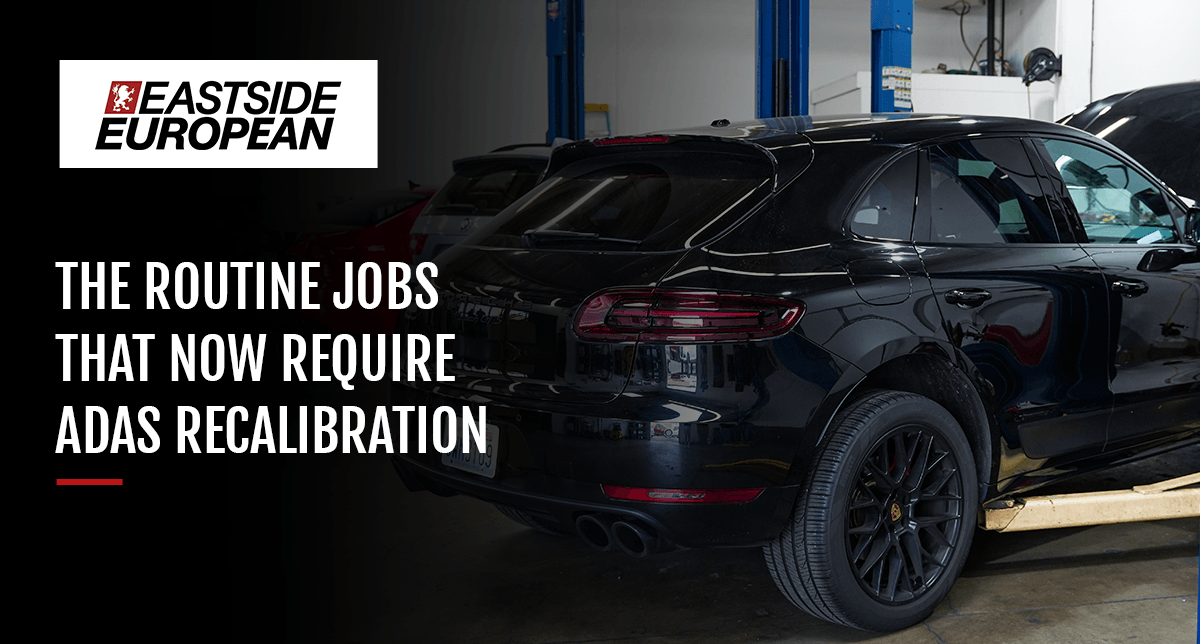
The Routine Jobs That Now Require ADAS Recalibration
Most owners have worked out that replacing a windshield means recalibrating the camera behind it. That one has become common knowledge.
Here is the one that catches people out: a wheel alignment.
At least 11 of the 28 North American manufacturers require an ADAS calibration after an alignment on equipped vehicles. Kia requires it after every alignment on cars that have the system. On BMW, a change to rear toe can trigger it.
An alignment. One of the most ordinary jobs in the trade, on a car nobody crashed, with nothing removed and nothing replaced.
We have written separately about what these systems are and why calibration matters. This article is the practical half — which everyday jobs now carry a calibration, why the car gives you no clue when one was skipped, and how to avoid being surprised by the line item.
The trigger list
The common thread is simpler than it looks. These systems are aimed relative to the car’s geometry and direction of travel. Change the geometry, change where the car points relative to where the sensor thinks it points, or move a sensor’s mounting or field of view — and the aim needs re-establishing.
Job
Why it triggers calibration
Wheel alignment — toe, camber, caster
Camera aim is referenced to the direction the car actually travels. Adjust toe and the car still tracks straight, but the camera is no longer looking down the true direction of motion.
Suspension work — struts, shocks, springs, control arms
Changes ride height and therefore the angle at which every forward-facing sensor looks at the road.
Steering repairs — tie rods, steering rack
Same principle: these alter the relationship between the wheels and the sensors.
Ride height or load changes, including air suspension work
Ride height is one of the factory geometry references the sensors depend on.
Subframe or chassis adjustment
Moves the mounting reference for everything attached to it.
Steering angle sensor service
Required by OEM procedure — the system needs to know true straight-ahead.
Windshield replacement
The forward camera is mounted to the glass. Most manufacturers require recalibration afterwards.
Bumper removal or reinstallation
The front radar sits at or behind the bumper fascia on most platforms. Nissan, for instance, requires radar recalibration after front-end work that shifts, removes or reinstalls the sensor.
Tire replacement or a change in tire size
Rolling diameter and ride height feed the system’s calculations. Ford states it does not validate ADAS performance on wheel and tire combinations it has not sanctioned.
That last row deserves a note, because it is the one with a decision in it. If you change to a different wheel or tire size — a staggered setup, a plus-size, winter wheels on a smaller diameter — you may be operating the driver assistance systems outside the parameters the manufacturer validated. Worth asking about before you buy the wheels rather than after.
And one honest caveat on the whole table: requirements change, and they vary by model year and trim. Two cars that look identical on the forecourt can have different procedures. The only reliable answer is the OEM service information for your specific vehicle, which is what a shop with the factory platform looks up.
Why it is not optional, and why that is hard to feel
This is the part that matters most, and it is genuinely counterintuitive.
A car with misaligned sensors drives perfectly normally.
There is usually no warning light, no message, no change in how the steering feels. The systems do not switch off — they keep working, from a slightly wrong idea of where the road is. Which means the failure mode is not “broken.” It is “working, but wrong” — and that is the worst kind of fault to have in a safety system, because nothing prompts you to question it.
What goes wrong, specifically:
- Lane departure and lane keeping misread your position in the lane — nudging when you are centred, or failing to nudge when you are drifting.
- Adaptive cruise misjudges following distance, either holding too far back or closing too much.
- Forward collision warning fires when it should not — or, more seriously, later than it should.
- Steering assist drifts or overcorrects, which owners usually describe as the car feeling “nervous” rather than as a fault.
You bought those systems. They were part of the price of the car and they are the part designed to work on the day something goes wrong. A couple of degrees of error in where a camera is looking is not a cosmetic issue.
Static, dynamic, or both — which explains the cost
Calibration appeared in 28.3% of repair estimates in 2025, up from 21.8% in 2024, and adds roughly $688 on average when it appears. Here is where that goes, because it is not a markup on a software button.
Static calibration happens indoors, stationary, using manufacturer-specific target boards aligned to the vehicle’s centreline. The requirements are physical and strict:
- A level floor — within roughly one degree of variance
- Controlled lighting with no shadows or glare falling on the targets
- Measured clear space in front of the vehicle, commonly 6 to 20 feet depending on the model, and up to around 25 feet on some
- A stable, climate-controlled environment
Dynamic calibration is a guided road drive under a prescribed procedure — specified steady speeds for a set period, typically somewhere between 15 and 60 minutes, with clear lane markings for the camera to learn from.
And some vehicles require both, in sequence: a static calibration in the bay, then a dynamic procedure on the road to fine-tune. Certain Audi Q7 and Q8, some BMW X5 and X7 model years, and selected Mercedes S-Class variants are among the cars that can need the full sequence.
So the line item is floor space, calibrated targets, a current software subscription, and an hour or more of a technician’s time — including, on some cars, driving yours on the freeway.
It also explains something worth knowing as a customer: a shop without a level floor, measured target space and controlled lighting cannot perform a static calibration correctly, whatever equipment it owns. That is not a criticism of anyone — it is geometry. It is also why a mobile windshield service working in your driveway on a damp morning cannot meet the static conditions, and why the cheapest glass quote is frequently the one that quietly leaves the calibration out.
The Pacific Northwest problem nobody mentions
Here is a local wrinkle we deal with every winter and have never seen written down.
Dynamic calibration needs clear lane markings, steady speeds and reasonable visibility. Those are exactly the things our winter takes away. Heavy rain and road spray, low light on short days, and faded or standing-water-covered markings on stretches of I-405 and SR 520 can all stop a dynamic procedure from completing. When it fails, it has to be re-attempted — sometimes on a different day, in better conditions.
Three practical consequences:
- Book ADAS-related work with time margin in winter. A job that takes an afternoon in July can need a second attempt in December.
- Do not leave it to the day before a trip. If your windshield needs replacing before you drive over the pass, give it a few days of slack.
- Expect an honest shop to tell you it is not finished yet. A calibration that did not complete is not a calibration. We would rather keep the car another day than hand it back and call it done.
How to avoid being surprised by the line item
Five things, all of which take one sentence to ask.
1. Ask before you authorise. “Does this job require a calibration on my car, and is it in the estimate?” Any shop with the factory information can look it up by VIN in a couple of minutes. This single question prevents almost every unpleasant surprise in this article.
2. Ask for a pre-repair scan. Scanning before work starts identifies which calibrations the job will require, and documents any faults that were already present. It protects both sides — you are not charged for something pre-existing, and the shop is not blamed for it.
3. Treat a cheap windshield quote with suspicion. On a car with a forward-facing camera, the glass is the small part of the job. A quote materially below the others is often a quote without calibration in it, and you will not find out from how the car drives.
4. Ask about wheels and tires before you buy them. If you are changing diameter or width, ask whether that keeps the driver assistance systems inside validated parameters.
5. Keep the documentation. Calibration records matter for insurance, and they matter at resale on a car where a buyer may reasonably ask whether the safety systems were ever properly re-aimed.
Frequently asked questions
Does a wheel alignment really require ADAS calibration?
On a significant share of cars, yes — at least 11 of the 28 North American manufacturers require it after an alignment on equipped vehicles, Kia requires it after every alignment on cars with the system, and on BMW a rear toe change can trigger it. The reason is that camera aim is referenced to the direction the car actually travels, so adjusting toe can leave the camera looking slightly off the true direction of motion even though the car tracks straight. Requirements vary by model year, so it has to be checked against OEM information for your specific vehicle.
How would I know if my sensors are out of calibration?
Generally you would not, and that is the problem. There is usually no warning light and no change in how the car drives. The systems keep operating from a slightly wrong idea of where the road is — lane keeping misreading your position, adaptive cruise misjudging distance, forward collision warning firing incorrectly or late, steering assist drifting. The failure mode is “working, but wrong” rather than “broken,” which is why it has to be handled procedurally rather than by waiting for a symptom.
Why does calibration cost what it does?
It appeared in 28.3% of 2025 repair estimates, up from 21.8% in 2024, and adds about $688 on average. A static calibration requires a floor level to within roughly a degree, controlled lighting with no glare on the targets, manufacturer-specific target boards aligned to the vehicle centreline, and measured clear space of commonly 6 to 20 feet — up to around 25 on some models. A dynamic calibration is a guided road drive at specified speeds for 15 to 60 minutes. Some cars need both in sequence.
Can a mobile windshield service calibrate my camera?
Not a static calibration, no — the conditions cannot be met in a driveway. Static procedures need a level floor, controlled lighting and measured clear space around the vehicle. Some vehicles can be completed with a dynamic procedure alone, but many require a static calibration or both in sequence. If a quote does not mention calibration on a car with a forward-facing camera, ask directly whether it is included and how it will be performed.
Will changing my wheel or tire size affect the systems?
It can. Rolling diameter and ride height feed into the system’s calculations, and Ford, for example, states that it does not validate ADAS performance on wheel and tire combinations it has not sanctioned. If you are considering a plus-size setup, a staggered fitment or winter wheels in a different diameter, ask before buying whether that keeps the driver assistance systems within validated parameters.
Why might calibration take longer in winter here?
Because dynamic calibration needs clear lane markings, steady speeds and reasonable visibility, and a Pacific Northwest winter removes all three. Heavy rain, road spray, low light and markings obscured by standing water can prevent the procedure completing, in which case it has to be re-attempted — occasionally on a better day. Book ADAS-related work with some time margin between November and March, and do not schedule it for the day before a trip.
Ask us before you authorise the job
If you have an alignment, suspension work, a windshield or any front-end job coming up, ask us whether it carries a calibration on your specific car. We will look it up by VIN and put it in the estimate up front rather than at the end — and if a procedure does not complete, we will tell you it did not.
Eastside European Auto Service and Repair has been the Eastside’s dealer alternative since 2010, working on Mercedes-Benz, BMW, Audi, Volkswagen, Volvo, Porsche, Jaguar, Land Rover, MINI and Smart. ASE-certified technicians, over 75 years of combined experience, factory-level diagnostic equipment, and loaner cars available.
Call 425-823-8200 or book online. 12415 NE 124th St, Kirkland, WA 98034. Serving Kirkland, Bellevue, Bothell, Redmond, Issaquah, Mercer Island and Woodinville.