
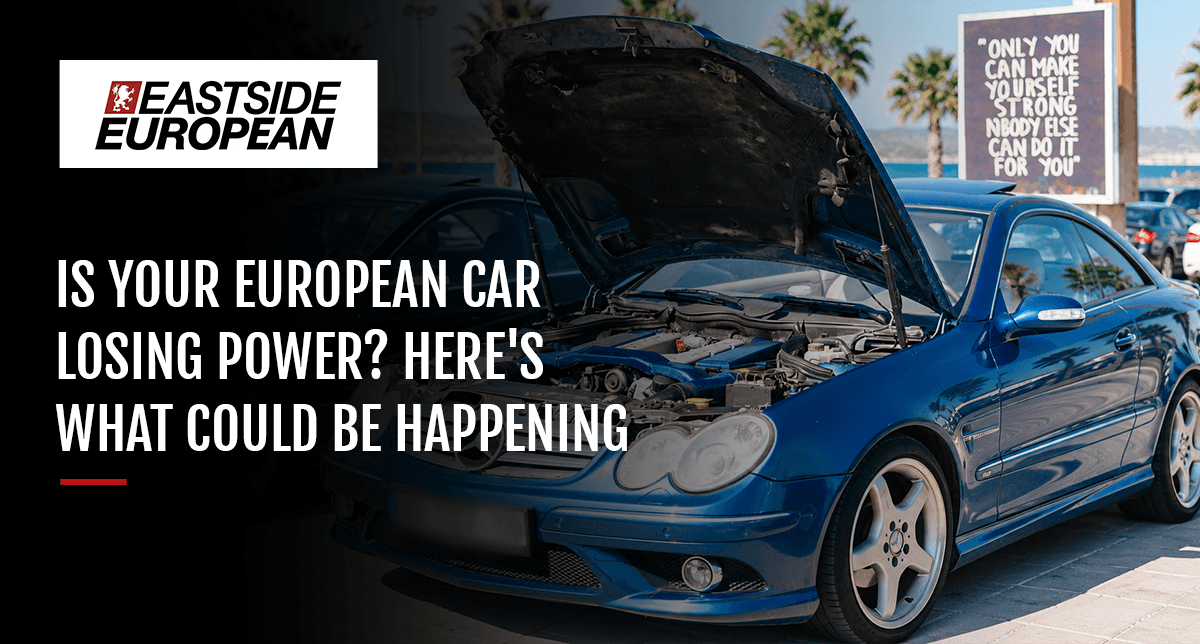
“It’s lost power” describes two completely different problems, and the first question worth answering is which one you have.
Did it happen at a specific moment? One drive, one merge onto 405, and the car suddenly would not pull. That is almost always the car deliberately limiting itself, because it detected something it did not like. It is a software decision, not a mechanical collapse.
Or did you only notice it in hindsight? The car feels flat, overtaking takes more planning than it used to, and you cannot say when it started. That is something physically restricted, leaking or worn — and it has been getting worse for months.
Those two lead to entirely different diagnostics, different urgency, and different bills. Sorting them is the useful first step.
| Sudden | Gradual | |
| What it usually is | The car protecting itself — limp mode | Restriction, leak or wear |
| Warning light | Usually yes | Often none |
| Does restarting help? | Frequently, temporarily | No |
| Urgency | Diagnose before driving hard again | Book it, but it is not an emergency |
| Where the answer lives | Stored fault codes and freeze frames | Measured pressures and flow |
Sudden power loss: your car did this on purpose
Modern European cars do not simply lose power. They withdraw it.
When a control module sees a value outside the range it trusts, it protects the engine by capping what you can ask for — limiting fuel, limiting boost, capping throttle opening, sometimes holding a single gear. Cars call it limp mode, reduced power mode, or on some models a straightforward “Drivetrain malfunction” message.
That is genuinely good news for two reasons. The car prevented damage rather than allowing it. And because the decision was deliberate, it is logged — there is a stored fault with freeze frame data describing exactly what conditions triggered it.
Which is why the request from our last piece on recurring warning lights applies doubly here: do not clear the code. On a sudden power loss, that stored snapshot is most of the diagnosis.
The boost loop, and why it is usually the culprit
Nearly every European engine sold in the last decade is turbocharged, and boost is a closed loop. The engine control module commands a target boost pressure, then measures what actually arrived using the manifold pressure sensor and, on many engines, a dedicated boost sensor. If commanded and actual disagree by more than the module tolerates, it sets a fault and pulls power.
You will see this as P0299 (underboost) or P0234 (overboost). The common causes, in roughly the order we find them:
Charge air pipes, hoses and clamps. Air leaking out after the turbocharger and before the engine never reaches the cylinders. Several European engines use plastic charge pipes that become brittle with heat cycling and split — and when one lets go, the power loss is instant and dramatic, often with an audible pop or a loud whoosh under acceleration. If your power loss arrived with a noise, say so immediately; it shortens the diagnosis to minutes.
The diverter valve. Particularly common on Volkswagen and Audi engines, where the valve’s rubber diaphragm tears after years of oil residue and heat. Air that should be pressurising the engine is recirculated instead.
The wastegate and its actuator. The wastegate regulates boost by bleeding exhaust past the turbine. When its actuator fails, the wastegate can default open — at which point the turbo builds very little boost at all. On diesels, the equivalent is variable-geometry vanes sticking with soot.
Vacuum lines. Unglamorous, cheap, and a real cause. Boost control on many of these engines depends on vacuum integrity.
The other sudden-loss triggers
Not everything sudden is boost.
Throttle and pedal sensor disagreement. These systems are redundant by design — two sensors, cross-checked. When they disagree, the module cannot know which to trust and defaults to minimal throttle. Dramatic, alarming, and usually a sensor or connector rather than anything expensive.
Transmission protection. If the transmission control module detects slip, pressure or temperature outside limits, it will hold a gear or refuse to shift. Drivers almost always report this as the engine losing power.
A misfire severe enough to trigger protection. When misfire counts pass a threshold, the module cuts fuel to the affected cylinder to protect the catalytic converter. You lose a quarter or a sixth of the engine, instantly.
If your car is in limp mode right now: get it off the freeway, restart it once to see whether the fault clears, and if it does, note that it did — a fault that clears on restart and returns under load is behaving very differently from one that stays. Then stop driving it hard until it is looked at. Limp mode is the protection working; overriding it with a heavy right foot is how a cheap repair becomes an expensive one.
Gradual power loss: follow the flow
Slow decline is a different investigation. Air in, fuel in, spark, exhaust out — something along that path is restricted, and the engine is doing its best around it.
Air in. Start with the genuinely mundane: a clogged air filter. Then intake boots that have gone soft and collapse under suction, and on direct-injection engines, carbon buildup on the intake valves. That last one is worth its own article — it is a defining characteristic of these engines, it develops slowly, and it is closely tied to oil consumption.
Boost, over time. A turbocharger with worn bearings or shaft play loses efficiency gradually rather than failing outright. On diesels, soot progressively stiffens the variable-geometry mechanism until it cannot move through its full range.
Fuel. A tired fuel filter or a high-pressure fuel pump losing its ability to maintain rail pressure produces a very characteristic complaint: the car is entirely normal at light throttle and falls apart when you ask for everything. If your power loss only exists above half throttle, fuel delivery goes to the top of the list.
Spark. Ignition coils frequently fail selectively — fine cold, failing once hot. And European long-life spark plugs are long-life, not lifetime; past their interval they raise the voltage demand on the coils, which is how one neglected service turns into two.
Exhaust out. This one gets missed constantly. A partially blocked catalytic converter creates backpressure the engine has to push against. The signature is unmistakable once you know it: perfectly fine at low rpm and light load, then it hits a wall and will not rev out. The engine feels strangled, because it is.
Diesel particulate filters deserve a specific local warning. A DPF collects soot and periodically burns it off in a regeneration cycle that requires sustained higher exhaust temperature — which means sustained driving. A commute from Kirkland to Bellevue or Redmond, six to ten miles in traffic, can repeatedly start a regeneration and never finish one. Soot accumulates, the car reduces power to protect the filter, and eventually it will not clear itself at all. If you drive a European diesel on short Eastside trips, this is the single most likely explanation for gradual power loss, and a longer sustained drive every few weeks is genuinely preventive maintenance.
Cam timing. A stretched timing chain retards valve timing, which quietly costs power well before it makes the rattle everyone listens for.
Four causes that are not the engine at all
This is where owners most often misdiagnose themselves, and all four are worth checking before anyone opens anything.
1. The transmission — and the “lifetime fluid” problem.
A torque converter that no longer locks up cleanly, or a transmission shifting on degraded fluid, feels exactly like an engine that has lost its edge. Symptoms to recognise: a faint groan or flare on a cold start, shifts that hang a beat longer than they used to, an occasional harsh downshift, or a shudder as the torque converter locks.
Here is the part worth knowing. BMW and several others market the fluid in the ZF 8-speed automatic as lifetime. ZF, who designed and built it, publishes a service interval. The figures in circulation vary, but the practical guidance from the manufacturer of the unit lands in the region of 50,000 to 90,000 miles, sooner under heat and load — and “lifetime,” in practice, means the length of the warranty. None of those symptoms above are normal, and none of them are the engine.
2. Brake drag.
If a caliper slide seizes or an electric parking brake actuator sticks, your engine is making exactly the same power as always — you are simply dragging a brake everywhere you go. The tells are a wheel noticeably hotter than the others after a drive, a drop in fuel economy that arrived alongside the power complaint, and sometimes a hot smell. In a damp climate, corrosion on caliper slides and brake hardware is ordinary, and this is more common here than in dry states.
3. Fuel octane.
Most European performance engines are calibrated for high-octane fuel. When a knock sensor detects detonation, the module protects the engine by retarding ignition timing — and retarded timing is, directly, less power. It is entirely real, entirely reversible, and free to test.
Two things make this more relevant here than in much of the country. Premium in Washington is typically 91 octane, where much of the eastern United States sells 93. And a single tank of regular in a car that wants premium will produce exactly this complaint. If your power loss followed a fill-up, run a tank of premium through before spending anything.
4. Altitude and heat.
A naturally aspirated engine loses roughly 3% of its power per 1,000 feet of elevation. Snoqualmie Pass summit sits around 3,000 feet, so a car that feels gutless climbing toward the pass and fine again in Kirkland is behaving exactly as physics requires. Turbocharged engines compensate for this far better, which is one reason they dominate. Hot weather has a smaller version of the same effect, along with heat soak in the intake on a long climb.
What to tell us so this takes one visit
Power complaints are among the easiest things to diagnose efficiently when described well, and among the most expensive to chase when not.
- Sudden or gradual? The single most important distinction, and only you know it.
- At what throttle opening? Only above half throttle points at fuel delivery or boost. Everywhere, including gentle driving, points elsewhere.
- Cold or warm? Faults that appear only after twenty minutes point at coils, sensors and heat-related failures.
- Does a restart restore it? A fault that clears on restart and returns under load is a different animal from one that stays.
- Is a light on, or was one on? And please, leave it on.
- Did you hear anything? A pop or a whoosh at the moment it happened is frequently the entire answer.
- What happened just before? A fill-up, a long climb, a cold snap, a service.
Frequently asked questions
What is limp mode, and is it safe to drive in?
Limp mode is your car deliberately limiting power — restricting fuel or boost, capping throttle, sometimes holding one gear — because a module detected a value it does not trust. It is designed to get you off the road safely, not to be driven on indefinitely. Get to somewhere safe, avoid heavy throttle, and have the stored fault read before driving hard again. Do not clear the code; the freeze frame data recorded when it triggered is most of the diagnosis.
Why does my car only lose power above half throttle?
Because that is when the engine demands maximum fuel and maximum boost, and a system that is merely marginal at light load becomes inadequate at full load. The usual causes are a high-pressure fuel pump that cannot maintain rail pressure, a restricted fuel filter, or a boost leak that only matters once the system is pressurised. A car that is completely normal in gentle driving and flat when pushed is describing a supply problem rather than a mechanical one.
Can a clogged catalytic converter cause power loss?
Yes, and it is frequently missed. A partially blocked converter creates backpressure the engine must work against. The signature is being fine at low rpm and light load, then hitting a wall and refusing to rev out — the engine feels strangled. Worth noting that converters do not block on a healthy engine; something upstream, usually a misfire or oil consumption, put them in that state.
I drive a European diesel on short trips and it feels slow. Why?
Almost certainly diesel particulate filter loading. The DPF burns off accumulated soot during a regeneration cycle that needs sustained higher exhaust temperatures, which means sustained driving. A six-to-ten-mile commute in Eastside traffic can start regenerations repeatedly and never complete one. The car then reduces power to protect the filter. A longer continuous drive every few weeks genuinely helps; once it has loaded badly enough, it needs intervention.
Could my transmission be the problem rather than the engine?
Very possibly, and owners rarely suspect it. A torque converter that no longer locks up cleanly, or a transmission working on degraded fluid, feels like an engine that has lost its edge. Look for a groan or flare on cold start, shifts that hang, harsh downshifts or a shudder under light acceleration at steady speed. Note also that while some manufacturers market the fluid in the ZF 8-speed as lifetime, ZF itself publishes a service interval — broadly in the 50,000 to 90,000 mile region, sooner under heat and load.
Does using 91 octane instead of 93 actually reduce power?
It can, on engines calibrated for higher octane. When the knock sensor detects detonation, the module retards ignition timing to protect the engine, and retarded timing means less power. Premium in Washington is typically 91 where much of the eastern US sells 93, so European engines here are often operating with slightly less timing than their calibration ideally wants. More to the point: a single tank of regular fuel in a car that requires premium produces exactly this complaint, and it is free to rule out.
Tell us when it happened, not just that it happened
Sudden or gradual, what throttle opening, cold or warm, and whether you heard anything. Four answers and we are most of the way there before the car goes on a lift.
Eastside European Auto Service and Repair has been the Eastside’s dealer alternative since 2010, working on Mercedes-Benz, BMW, Audi, Volkswagen, Volvo, Porsche, Jaguar, Land Rover, MINI and Smart. ASE-certified technicians, over 75 years of combined experience, factory-level diagnostic equipment, and loaner cars available.
Call 425-823-8200 or book online. 12415 NE 124th St, Kirkland, WA 98034. Serving Kirkland, Bellevue, Bothell, Redmond, Issaquah, Mercer Island and Woodinville.